VLA-FixBench
Can VLMs Diagnose and Recover from VLA Manipulation Faults?
ICML 2026
Bowen Yan†, Jiahao Xiao†, Kehui Liu, Jianbo Zhang, Zicheng Zhang, Qi Jia, Zhongjie Jia, Haoming Song, Chunyi Li, Bin Zhao, and Guangtao Zhai.
† Equal contribution.
Shanghai AI Laboratory · Shanghai Jiao Tong University · Nanyang Technological University
Can a model that explains a robot’s failure also help it recover? VLA-FixBench evaluates the gap between understanding a manipulation fault and producing a recovery action that works in the physical world.
What does the benchmark measure?
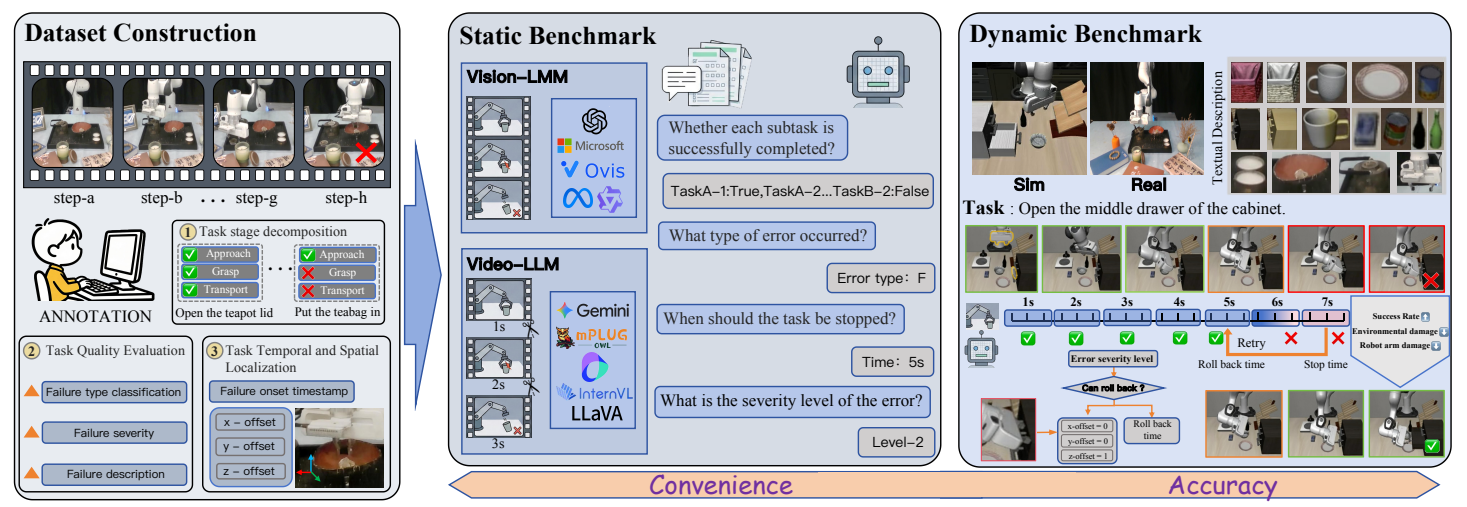
VLA-FixBench contains 6,034 task-execution episodes from 40 simulated task settings and two real-robot tasks: tea preparation and charging-plug insertion. Annotations describe task stages, fault types, severity, failure timing, and spatial deviations. The dataset includes both failed and error-free executions.
The accompanying FaultEval framework evaluates 20 VLMs across complementary settings:
- Static diagnosis: identify the fault, estimate its severity, and determine which subtasks succeeded.
- Dynamic evaluation: locate when execution should stop and roll back, estimate a 3D correction, and measure task completion in simulation.
- Real-robot evaluation: test whether diagnostic decisions translate into effective recovery on a Franka arm.
How does recovery work?
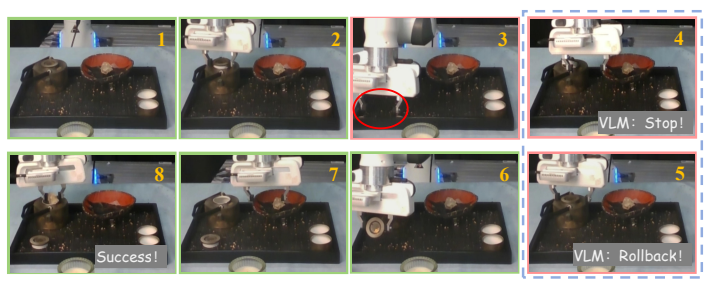
The collaboration interface follows a detect → rollback → correct sequence:
- Detect and stop. Identify a failure and choose when to pause execution.
- Roll back. Select an earlier safe state in the execution history.
- Correct and resume. Apply a 3D spatial offset and continue the task with the VLA policy.
On the real robot, diagnosis uses a pause-and-inspect protocol. The VLA executes for a one-second window, then robot motion and VLA inference pause while the VLM inspects the recorded segment. Each task typically involves three to six diagnoses; this is not continuous, latency-free intervention.
Key findings
Good diagnosis does not guarantee successful recovery. Models must identify a useful rollback point and produce a sufficiently precise spatial correction. Incorrect interventions can interrupt trajectories that would otherwise succeed.
The real-robot results illustrate this gap:
| Setting | Task success rate |
|---|---|
| GR00T-N1.5-3B policy without a VLM judger | 30% |
| Best automated VLM-assisted result in Table 3 (Gemini-2.5-Flash) | 25% |
| Human-expert intervention, used as an upper bound | 65% |
The 35-percentage-point improvement (30% → 65%) is the human-expert upper bound, not an improvement achieved by the automated VLM judgers. All evaluated automated judgers in Table 3 remain below the VLA-only baseline. The human result demonstrates the potential of accurate recovery decisions; the automated results reveal the grounding and intervention problems still to solve.
Takeaway
VLA-FixBench provides a testbed for evaluating both failure understanding and executable recovery. The results motivate more accurate temporal and spatial grounding, confidence-aware intervention, and safer correction policies—not simply more frequent fault detection.
Dataset and setup: Section 3 and Appendix A. Recovery interface: Section 4.2. Real-robot results: Table 3. Inspection protocol and limitations: Section 5.4.